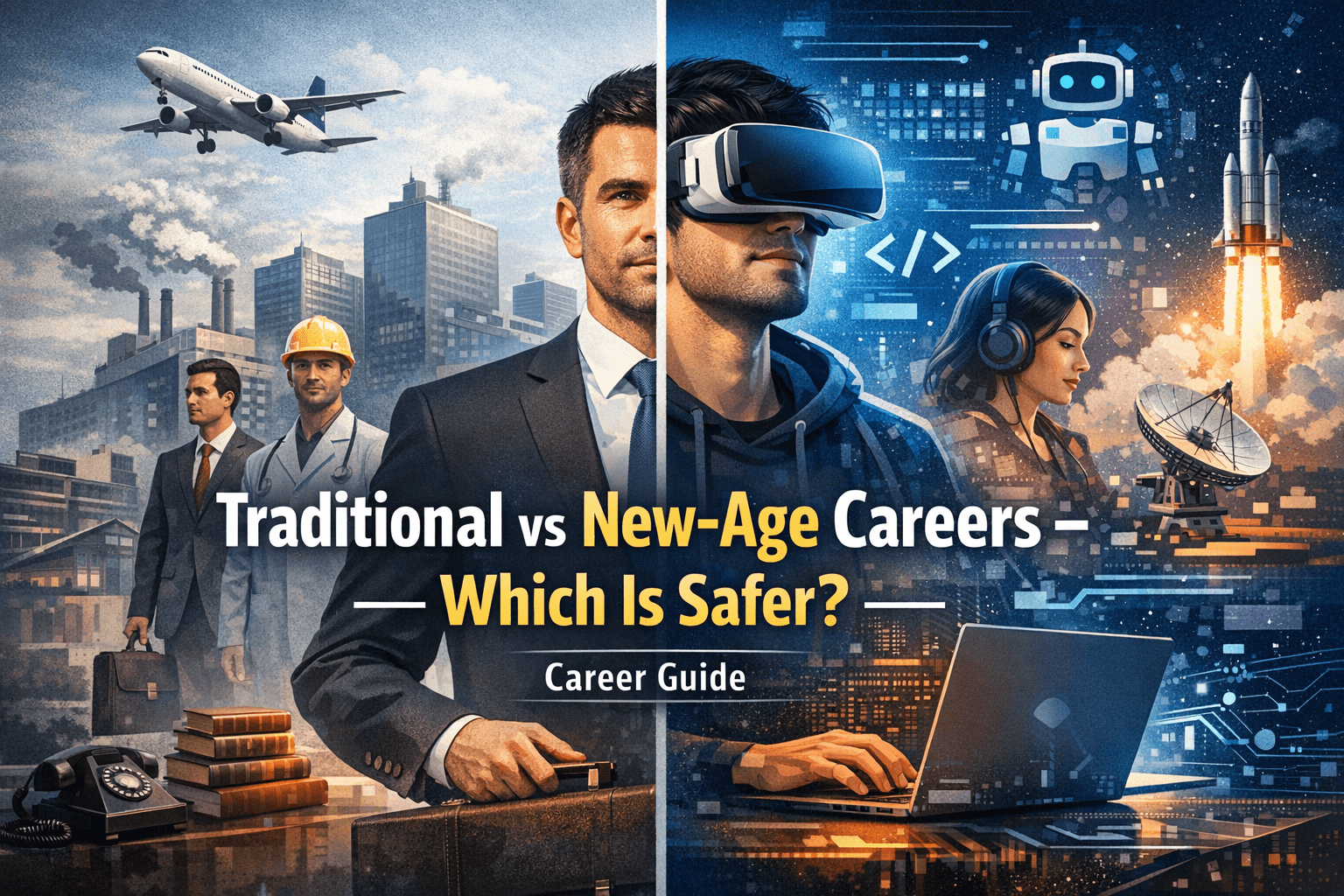
Traditional vs New-Age Careers – Which Is Safer?
The world of work is changing faster than any generation has ever witnessed. Artificial Intelligence, automation, remote work, global freelancing, and digital platforms have transformed how careers are built, sustained, and disrupted.
For decades, traditional careers—such as engineering, medicine, law, teaching, and government jobs—were considered the safest and most respectable options. Parents trusted them. Society endorsed them. Banks approved loans based on them.
But today, new-age careers—like data science, digital marketing, UX design, AI engineering, product management, content creation, and startup entrepreneurship—are challenging that belief.
This raises a crucial question for students, parents, and working professionals:
Which is actually safer today—Traditional Careers or New-Age Careers?
Safety is no longer just about stability. It includes:
- Income sustainability
- Skill relevance
- Career growth
- Global opportunities
- Adaptability to change
This comprehensive guide breaks down traditional vs new-age careers with clarity, data, and practical career strategy—helping you choose the right path for long-term success, not just short-term comfort.
Understanding Traditional Careers
What Are Traditional Careers?
Traditional careers are profession-based roles that have existed for decades and follow a linear career progression model.
Common Traditional Careers Include:
- Doctors
- Engineers
- Lawyers
- Chartered Accountants
- Teachers & Professors
- Government Officers
- Bank Employees
- Architects
These careers typically require:
- Formal degrees
- Long academic pathways
- Licensing or regulatory approval
- Fixed organizational structures
Advantages of Traditional Careers
- Perceived Job Security
Traditional roles, especially government and public-sector jobs, offer predictable income and tenure-based promotions. - Social Recognition & Trust
Titles like “Doctor” or “IAS Officer” carry strong societal respect, especially in India and Asia. - Structured Career Path
Clear progression stages reduce uncertainty—intern → junior → senior → leadership. - Stability During Economic Downturns
Healthcare, education, and public administration tend to remain stable even during recessions.
Limitations of Traditional Careers
- Long Time to ROI
Years of education and training before earning begins. - Limited Income Scalability
Salary growth is often capped unless you reach top positions. - Slower Skill Evolution
Many traditional roles adapt slowly to technological changes. - Geographic Dependence
Jobs often require physical presence and location-specific licensing.
Understanding New-Age Careers
What Are New-Age Careers?
New-age careers are skill-centric, technology-driven, and global in nature. They evolve with market demand rather than academic tradition.
Examples of New-Age Careers:
- Data Scientist
- AI / Machine Learning Engineer
- Digital Marketer
- UX/UI Designer
- Product Manager
- Cloud Engineer
- Cybersecurity Analyst
- Content Creator & Influencer
- Startup Founder / Solopreneur
These careers prioritize:
- Skills over degrees
- Portfolios over certificates
- Continuous learning
- Outcome-based performance
Advantages of New-Age Careers
- Faster Entry into the Workforce
Bootcamps and online certifications allow career entry within months. - High Income Potential
Global clients, startups, and MNCs pay premium salaries for niche skills. - Location Independence
Remote jobs and freelancing allow global income from anywhere. - Rapid Growth & Role Flexibility
You can pivot roles without restarting your career. - Skill Ownership
Your career is not tied to a single employer.
Challenges of New-Age Careers
- Continuous Upskilling Required
Skills can become obsolete if not updated. - Income Volatility (Initially)
Freelancers and startups may face unstable income early on. - Lack of Traditional Validation
Older generations may not understand or trust these careers. - Self-Discipline is Critical
Success depends heavily on personal accountability.
Educational Pathways: Traditional vs New-Age
Traditional Career Education Pathway
- School (10+2 with specialization)
- Undergraduate Degree (3–5 years)
- Postgraduate / Licensing (optional but common)
- Competitive Exams (for government roles)
Time Investment: 5–10 years
Cost: High
Flexibility: Low
New-Age Career Education Pathway
- Any academic background (often flexible)
- Skill-based certifications
- Bootcamps & online courses
- Internships, projects, freelancing
Time Investment: 6 months – 3 years
Cost: Moderate to Low
Flexibility: High
Deep Dive: Skills That Decide Career Safety
Hard Skills (Technical)
| Traditional Careers | New-Age Careers |
| Subject expertise | Digital & technical tools |
| Legal/medical knowledge | Programming, analytics |
| Compliance-based | Innovation-driven |
| Static curriculum | Rapidly evolving |
Soft Skills (Universal Safety Net)
Regardless of career type, these skills future-proof your career:
- Critical thinking
- Communication
- Adaptability
- Problem-solving
- Emotional intelligence
- Leadership
- Learning agility
Insight: In the future, soft skills combined with technical skills will define career safety.
Comparison Table: Traditional vs New-Age Careers
| Career Type | Core Focus | Required Skills | Average Salary (USD / INR) | Career Growth Potential |
| Doctor | Patient care & diagnosis | Medical knowledge, empathy | $60k–$250k / ₹10–40 LPA | Stable, slow growth |
| Engineer (Core) | Infrastructure & systems | Technical fundamentals | $50k–$120k / ₹6–18 LPA | Moderate |
| Data Scientist | Data-driven decisions | Python, ML, analytics | $90k–$160k / ₹12–30 LPA | Very High |
| Digital Marketer | Online growth & branding | SEO, ads, analytics | $50k–$130k / ₹6–25 LPA | High & flexible |
Which Career Is Actually “Safer”?
Redefining Career Safety in 2026+
Old Definition of Safety:
✔ Fixed job
✔ Monthly salary
✔ Single employer
New Definition of Safety:
✔ Multiple income options
✔ Transferable skills
✔ Global demand
✔ Career adaptability
When Traditional Careers Are Safer
- You prefer structured environments
- You value long-term stability over speed
- You are academically inclined
- You aim for public-sector or regulated professions
When New-Age Careers Are Safer
- You enjoy learning and adapting
- You want faster financial growth
- You prefer skill ownership
- You want global or remote opportunities
- You are comfortable with calculated risk
The Smart Strategy: Hybrid Career Approach
The safest career path today is not choosing one side blindly—it is combining both.
Examples of Hybrid Careers:
- Doctor + Healthcare Technology
- Lawyer + Legal Tech
- Teacher + EdTech
- Engineer + AI / Data Science
- MBA + Product Management
Career winners of the future will be those who combine domain expertise with new-age skills.
Career Guidance for Students & Parents
For Students (Class 9–12)
- Focus on aptitude, not just marks
- Explore skill exposure early
- Avoid herd mentality
For Graduates
- Add at least one future-ready skill
- Build projects, not just resumes
- Explore internships & freelancing
For Parents
- Career safety ≠ old careers only
- Support skill-based growth
- Encourage adaptability
Conclusion: The Real Answer to Career Safety
There is no universally “safe” career anymore.
The safest career is one where:
- Your skills are in demand
- You can adapt to change
- You are not dependent on one role or employer
- You continuously learn and evolve
Traditional careers offer stability.
New-age careers offer scalability.
👉 The future belongs to those who strategically blend both.
If you choose wisely, invest in skills, and stay adaptable—any career can be safe, successful, and fulfilling.